Peru topographic maps
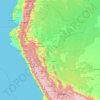
Click on a map to view its topography, its elevation and its terrain.
Lake Titicaca
Lake Titicaca has a surface elevation of 3,812 m (12,507 ft). The "highest lake" claim is generally considered to refer to commercial craft. Numerous smaller bodies of water (that are not considered lakes) around the world are at higher elevations. For many years, the largest vessel afloat on the lake was the…
Average elevation: 3,870 m
Manu National Park
Manu National Park covers an area of 1,716,295.22 hectares (17,162.95 km2) which comprises mountainous areas (traversed by creeks and valleys) with elevations close to 4000 m above sea level and a portion of the Amazon Basin plains.
Average elevation: 1,010 m


Machu Picchu
Peru > Cusco > Machupicchu > Intihuatana > San Miguel
Animals are also suspected to have migrated to Machu Picchu, as there were several bones found that were not native to the area. Most animal bones found were from llamas and alpacas. These animals naturally live at altitudes of 4,000 meters (13,000 ft) rather than the 2,400 meters (7,900 ft) elevation of Machu…
Average elevation: 2,225 m


Pacaya Samiria National Reserve
The annual mean temperature ranges between 20 and 33 °C, while the annual mean precipitation ranges between 2000 and 3000 mm. It is advisable to visit the reserve between May and January. The climograph shown here corresponds to the nearby town of Nauta (93 m of elevation).
Average elevation: 120 m
Tambopata National Reserve
The area consists of forested hills and plains, with elevations ranging from 200 to 400 m above sea level.[3] The area presents swamps, oxbow lakes and meandering rivers; the main rivers in the reserve being the Tambopata, Malinowski and Heath rivers.[3]
Average elevation: 239 m

Chachani Volcano
The volcano lies in the Andes of southern Peru, 22 kilometres (14 mi) northwest of Arequipa and north of the Arequipa Airport; the city of Arequipa is situated on the foot of Chachani and El Misti volcanoes. The road from Arequipa to Chivay runs along the southeastern foot of Chachani, and a dirt road reaches…
Average elevation: 5,562 m

Kuelap
Kuélap is located on a limestone ridge on top of a mountain at an elevation of 3000 metres, on the left bank of the Utcubamba River. It belongs to the district of Tingo, Luya Province, Amazonas. The area is covered with cloud forests, with a variety of trees, orchids and epiphytes. The protected zone covers…
Average elevation: 2,600 m
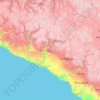
Arequipa
This department has a rough topography, which is characterised by heavy layers of volcanic lava covering large areas of its inter-Andean sector. It has deep canyons such as the ones formed by the Ocoña and Majes rivers. Plateaus range in height from medium, such as La Joya, and high-altitude ones such the…
Average elevation: 2,599 m




Nevado Coropuna
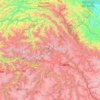
Coropuna is a dormant compound volcano located in the Andes mountains of southeast-central Peru. The upper reaches of Coropuna consist of several perennially snowbound conical summits, lending it the name Nevado Coropuna in Spanish. The complex extends over an area of 240 square kilometres (93 sq mi) and its…
Average elevation: 5,980 m












Laguna Aricota
Lake Aricota (possibly from Aymara ari pointed, sharp, quta lake) is a lake in Candarave Province, region of Tacna, Peru. It has an elevation of 2,800 metres (9,186 ft) above sea level.
Average elevation: 3,058 m




Province of Chucuito
One of the highest elevations of the province is Chuqi Patilla at approximately 5,200 m (17,100 ft). Other mountains are listed below.
Average elevation: 4,051 m


Chinchaypujio
The district of Chinchaypujio has a 2,000-metre (6,600 ft) altitude spread from south to north; hence, the district is home to multiple climate zones. In the south, the Apurímac River runs at 2,200-metre (7,200 ft) elevation where Banana Isla Maleño and other tropical fruit can be grown, in the north, the…
Average elevation: 3,604 m